
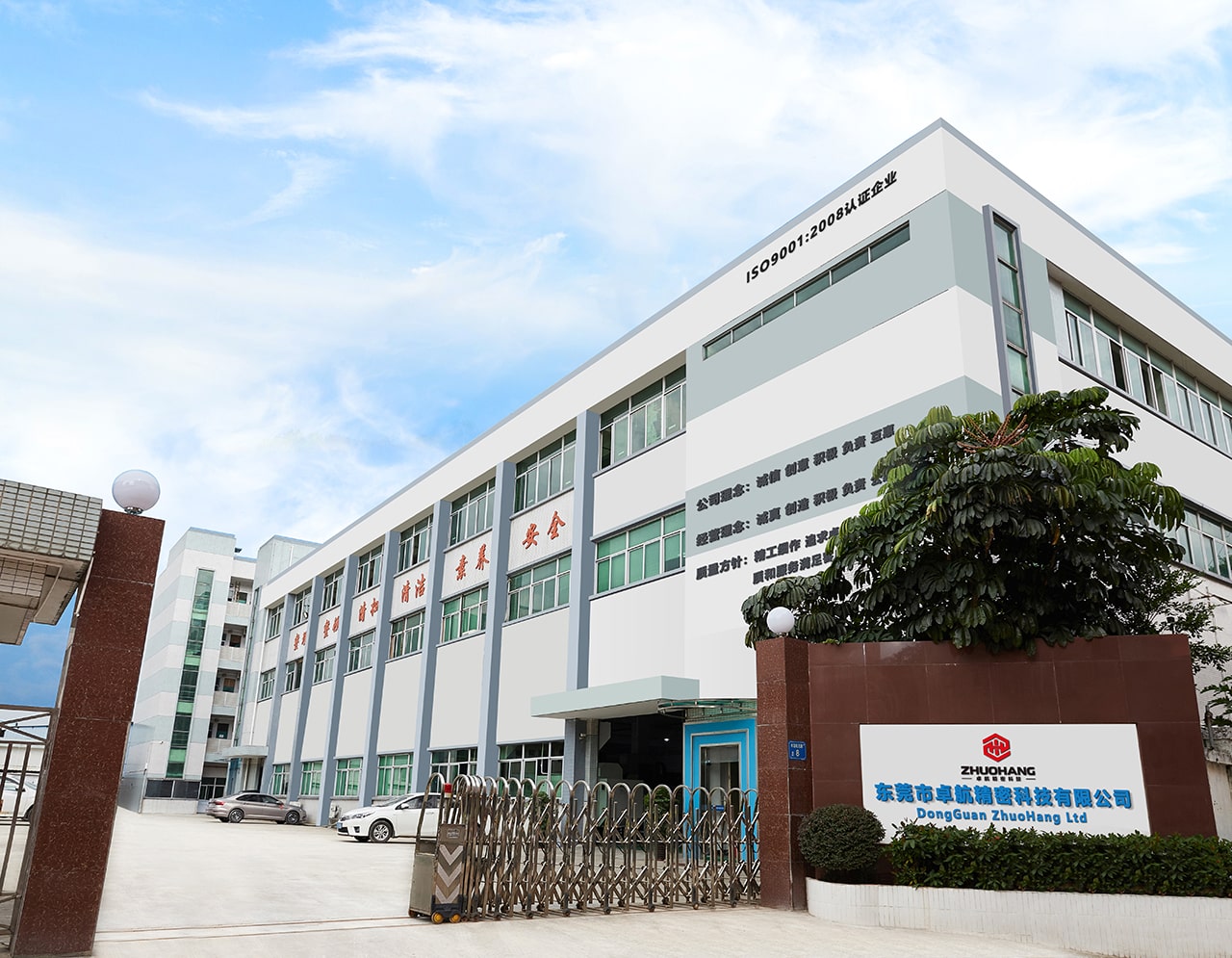
- Legal name: Dongguan Zhuohang Ltd, registration No. 91441900MA4UWT6X39, founded 2005.
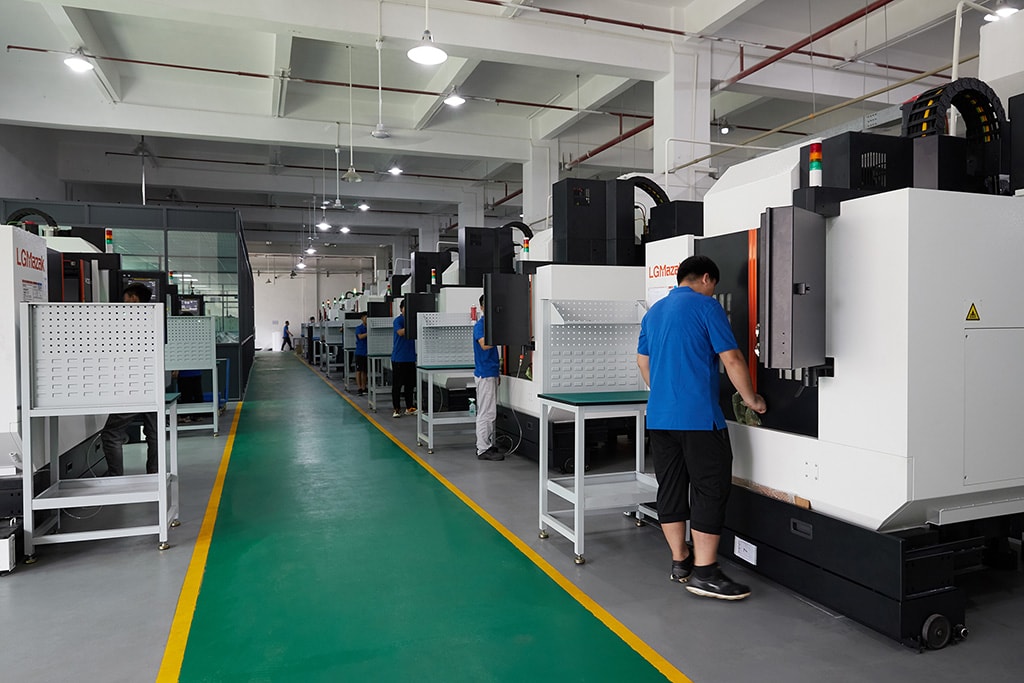
- Facility: 6,800 m², over a hundred machines, 100+ employees, 20+ inspection instruments.
- Lead tiers: ~3 / 7 / 30 days, scheduled by process steps.
- Certifications: ISO 9001, IATF 16949, ISO 14001 with stated numbers.
What is the legal identity of the factory?
The legal name is Dongguan Zhuohang Ltd, registration number 91441900MA4UWT6X39, founded in 2005 and operating from No. 8, Shuibian Songyuan Road, Hengli Town, Dongguan City, Guangdong Province, China. The marketing name is Zhuohang Precision Machining Factory, with the site brand Machined Metal Parts.
Why this matters to a buyer: a legal identity you can check against public records is the difference between a factory and a trading desk that resells someone else's capacity. Ask for the registration number, then verify it. A shop that hesitates to share it has not earned the order.
How does the factory's scale support lead times?
6,800 m² with 100+ production machines and 100+ employees means a job routes to the machine that cuts it fastest, and prototype and production volumes run on the same equipment without rescheduling the whole shop. A narrow shop slips when two jobs collide; a broad floor absorbs.
Scale works for you only when it is scheduled, not just present. A 6,800 m² floor with idle spindles delivers nothing faster than a small shop with a tight plan. The floor matters because it lets a job route to the right machine, not because the square meters impress anyone.
| Attribute | Value |
|---|---|
| Facility area | 6,800 m² |
| Production machines | 100+ |
| Inspection instruments | 20+ |
| Employees | 100+ |
| Founded | 2005 |
Which machines run on the floor?
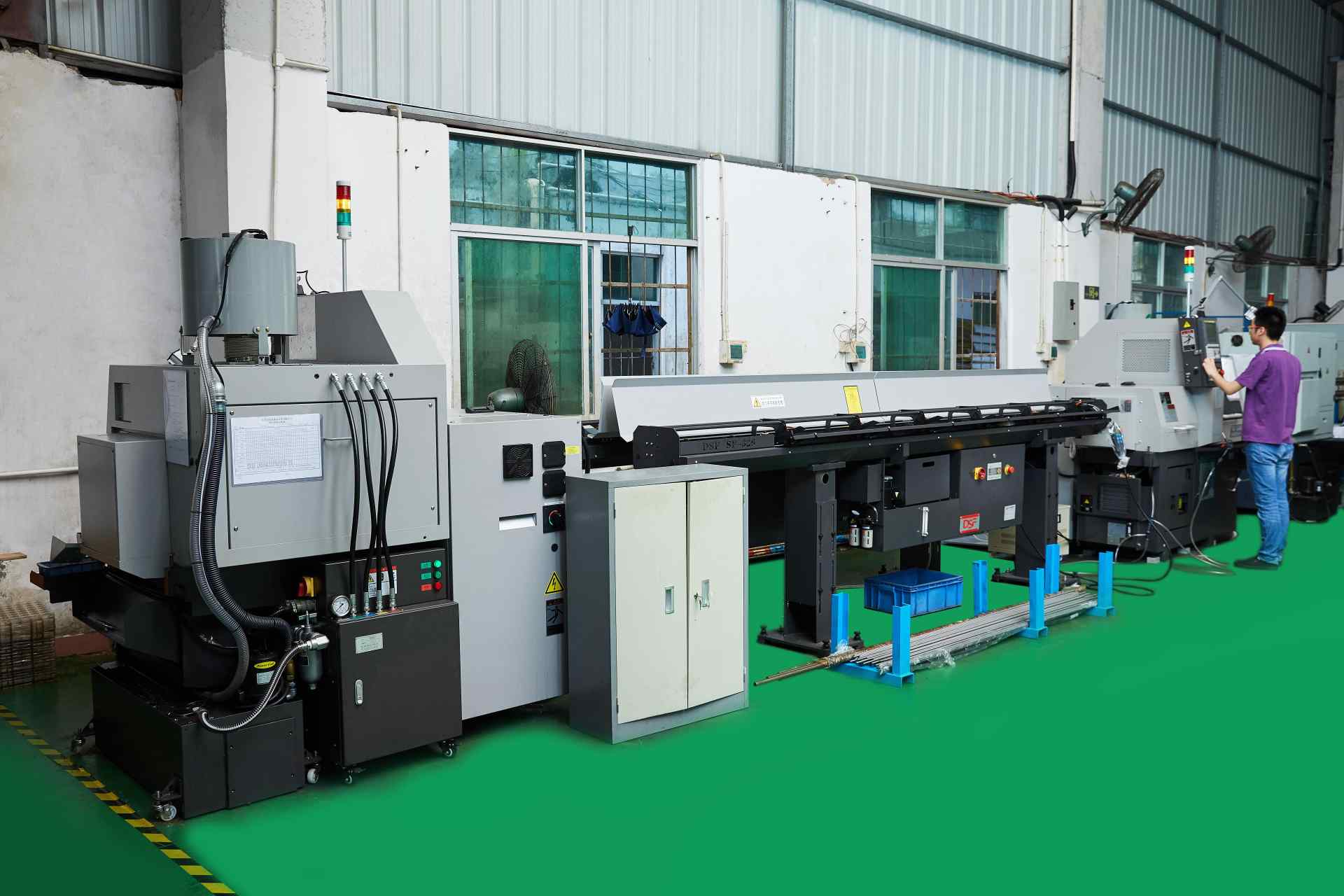
The machine mix is what makes a lead time short. 3-axis (50+), 4-axis (20+), and 5-axis (20+) milling, 25+ CNC lathes, mill-turn centers, and 7+ grinders from Mazak, Brother, Citizen, Star, and Tsugami — plus 20+ inspection instruments to keep rework off the schedule.
| Machine family | Count | Why it matters to a date |
|---|---|---|
| 3-axis milling | 50+ | Flat, prismatic parts cut quickly |
| 4-axis / 5-axis milling | 20+ / 20+ | Fewer setups on complex parts |
| CNC turning | 25+ lathes | Round parts in one operation |
| Grinding | 7+ | Tight finishes without rework |
Mill-turn centers fill the gap between milling and turning: a part with both milled flats and a turned bore stays on one machine instead of bouncing between two queues.
Which certifications does the factory hold?

| Standard | Certificate number | Scope |
|---|---|---|
| ISO 9001:2015 | 116024/A/0001/UK/En | Machining of metal parts |
| IATF 16949:2016 | 131941/A/0001/SM/En | Manufacture of CNC metal machining parts (excludes product design, Clause 8.3) |
| ISO 14001:2015 | 116024/B/0001/UK/En | Environmental management related to machining of metal parts |
Stated certificate numbers are what make a claim checkable. Any shop can print a logo; a number lets you confirm the scope and status with the registrar. Ask for the number, not the badge.
How does the floor plan for your volume?
Capacity planning is a two-way street. Share your annual volume and your ramp, and the factory reserves capacity so production lead times do not surprise you. Because the same equipment runs prototypes and production, the lead time you validate on a prototype is the lead time you can plan on in volume.
Before you commit volume to a factory, pin down three things:
- Can it absorb a spike without pushing your date? Ask how allocation is protected.
- Is the prototype line the same as the production line? If not, the validated lead time does not transfer.
- Who is accountable for the schedule? A named planner beats a shared inbox.
Can a buyer visit the factory before ordering?
A site visit is the strongest due-diligence step you can take, and a manufacturer that promises a lead time should welcome it. You can tour the floor, watch the inspection bench, and review the quality records in person.
On the visit, look past the welcome and check the shop floor signals:
- Are the machines loaded, and on what? An idle floor tells you about demand, not capability.
- Is the inspection bench in use, or staged? A bench that is staged for tours is not protecting your date.
- Do the quality records match the parts you see? Ask to trace one lot end to end.
Visits are arranged through the sales contact. The address is No. 8, Shuibian Songyuan Road, Hengli Town, Dongguan, Guangdong, China 523470.
What should a buyer confirm about the factory before committing?
Before you commit, run four checks. A factory that clears all four has earned the order; one that stumbles on any of them has told you something useful.
- The legal identity matches public records.
- The machine count is named, not generic.
- The capacity fits your volume.
- The certificate numbers are stated and verifiable.
How does the floor layout keep a schedule moving?
A schedule is only as good as the floor it runs on. A 6,800 m² floor means a job can stage at the machine, a finished batch can wait for inspection, and a large part has room to sit — without blocking the aisle or the next job. A cramped floor turns every hand-off into a traffic jam, and traffic jams show up as late dates.
Layout matters in the hand-offs. When raw stock, work-in-progress, and finished parts each have their place, the part moves from machine to machine without waiting for a path to clear. When they share one pile, the part waits behind everything else. The floor is not decoration; it is the schedule's plumbing.
How does staffing protect a delivery date?
Machines do not keep dates; people do. A schedule needs programmers to turn a drawing into toolpaths, setters to fixture the part, operators to run the machine, and inspectors to verify it. A shop with 80 machines and not enough of any one of those will idle spindles waiting for the next step.
The 100+ employees on this floor span those roles, so a job does not stall because the only programmer is busy or the only inspector is out. When you audit, ask who sets up, who programs, and who inspects — the answer tells you whether the machine count is real capacity or a list.
How does equipment maintenance protect the schedule?
A down machine is a slipped date, and maintenance is what keeps machines up. Preventative maintenance — scheduled checks and calibration on the Mazak, Brother, TSUGAMI, and Sodick machines — catches wear before it becomes a breakdown mid-run. A breakdown is not just a delay; it is a queue that pushes every job behind it.
Calibration matters to the date too, because a machine that drifts out of tolerance produces parts that fail inspection and have to be remade. A shop that calibrates on a schedule is protecting both the dimension and the delivery. Ask whether maintenance is scheduled or reactive; the answer is a preview of your date's reliability.
How does the factory verify it can meet your date?
Before a factory commits to a date, it checks the floor. Is there a spindle free in the right machine class? Is the material in stock or on order? Is a setter available? A factory that answers those three before quoting is giving you a date; a factory that answers after is giving you a wish.
The check is what separates a forecast from a guess. When the factory confirms the machine, the material, and the person, the date has three legs to stand on. When it skips the check, the date stands on one, and one leg is easy to knock over.
What does the factory's location mean for your schedule?
Dongguan sits in the Pearl River Delta, one of the densest manufacturing regions for precision machining, which means material, tooling, and finishing partners are close. Proximity shortens the hand-offs: stock arrives quickly, a broken tool is replaced quickly, and an outsourced finishing step does not add a long transit.
The location does not shorten the machining itself, that is set by the geometry and the material. It shortens the waits around the machining. A factory in a supply-dense region can turn those waits into hours instead of days, and the difference shows up in the lead-time tier.
How does the factory handle a rush order without breaking other dates?
A rush order is a test of the schedule, not of the machines. The factory that absorbs a rush without breaking its committed dates is the one running below full utilization, with headroom to re-route. The factory at full load either refuses the rush or breaks a promise to fit it in.
Headroom is the factory's honest answer to a rush. Because this floor runs prototype and production on the same equipment, a rush can slot onto a spindle without stealing another job's date. Ask what happens when you need it faster — the answer tells you whether the capacity is real or the floor is just full.
How does the factory keep the same process from prototype to production?
The prototype-to-production hand-off is where many schedules break. If the prototype ran on one line and production runs on another, the validated process and date do not transfer. This factory runs prototypes and production on the same equipment, so the fixture, program, and operator carry over.
The continuity is what makes the prototype date predictive. When the same setup that proved the first article runs the production batch, the lead time you measured is the lead time you can plan on. When the two differ, the prototype was a laboratory result, not a forecast.
How does the factory's capacity scale with your ramp?
Capacity planning is about the ramp, not just the first order. A factory that fits your prototype volume may not fit your production volume a year later, and the schedule changes when the factory crosses that line. Share the ramp — annual volume, peak months, and the growth curve — and the factory can reserve the spindles before the volume arrives.
The alternative is a scramble: you place the production order and the factory discovers it does not have the free capacity, so your parts wait. A factory that plans against your ramp holds the capacity in advance, and your production lead time stays what you were promised, not what was left over.
What this shop actually runs
Capability evidence should come as specifics, not slogans. Behind this guide is a 6,800 m2 plant in Dongguan, China running 100+ CNC machines with 100+ staff. The machine list by category:
- 5-axis machining centres (10+) - Mazak VARIAXIS I-600 (510/910/510 mm travel, 12,000 rpm, 22 kW, 71.6 N·m, 30-tool BT40) and Mazak INTEGREX I-250H S (B-axis 0.0001°, 24 kW, 124 N·m, 38-tool HSK-A63). Meant for compound-angle parts, single-setup multi-face prismatic work, and aerospace fittings where datum transfer loss is unacceptable.
- 3-axis / 4-axis machining centres (50+) - Brother SPEEDIO S500Z2N / S700Z2N (10,000 rpm, 14/21-tool ATC, 0.7 s tool-to-tool, Z-axis 2.2 G) and Mazak VCE-430A L / VCE-570C L (10,000 rpm, 118 N·m, 24-tool ATC). Meant for prismatic parts, plates, brackets, housings.
- Swiss-type turning centres (10+) - Citizen Cincom A20-3F7 (Φ20 mm, 10,000 rpm), TSUGAMI B0206-III / B0205-III (Φ20 mm, 0.1 µm), STAR SR-32JII / SR-32J Type N (Φ32 mm, 8,000 rpm). Meant for long, slender rotational parts at ±0.002 mm.
- CNC turning centres (20+) - HEADMAN T70M/1250 (720 mm swing, 117 mm bore, 3,000 rpm, BMT75 12-station turret). Meant for shafts, bushings, flanges up to ±0.002 mm.
- Wire EDM (5+) - Sodick AQ535L (550/350/300 mm travel, ±20° taper, 800 kg workpiece). Meant for hardened tool steel, internal splines, sharp internal corners that milling cannot reach.
- Inspection: Hexagon CMM + 20+ gauges - Hexagon CMM for coordinate measurement, plus vision system, profilometer, hardness tester, coating thickness gauge, XRF for material verification. The 10:1 rule (gauge 10x more accurate than the band) is applied to every feature.
- Machine highlights - VARIAXIS I-600: one-setup multi-face 5-axis + MAZA-CHECK auto-calibration; INTEGREX I-250H S: DONE-IN-ONE mill-turn, B-axis 0.0001° + Ai thermal shield; SPEEDIO S500Z2N / S700Z2N: Z-axis 2.2 G + 0.7 s ATC; Swiss-type: guide-bush switchable + 0.1 µm resolution.
Tolerance: ±0.003 mm CNC milling / ±0.002 mm CNC turning / ±0.002 mm grinding and wire EDM. Capability: Ppk >= 1.67 initial on key characteristics, Cpk >= 1.33 ongoing.
Certificates: ISO 9001:2015 (116024/A/0001/UK/En), IATF 16949:2016 (131941/A/0001/SM/En, with design clause 8.3 excluded, stated openly) and ISO 14001:2015 (116024/B/0001/UK/En), issued to Dongguan Zhuohang Ltd, registration 91441900MA4UWT6X39, founded 2005.
Where we ship: Austria, Belgium, the Czech Republic, Denmark, France, Germany, Greece, Hungary, Ireland, Italy, the Netherlands, Spain, Sweden and the United Kingdom in Europe; Brazil, Canada, Mexico and the United States in the Americas; China, Israel, Japan, Singapore and Sri Lanka in Asia; Australia and New Zealand in Oceania; and South Africa in Africa — plus other countries and regions worldwide, shipped from our base in Dongguan, China.
Contact: Felipe Iglesias, [email protected], +86 13126536955.
Visit the capacity behind your lead time
Email [email protected] or call +86 13126536955 to arrange a tour of the floor and the quality records.
Frequently Asked Questions
What is the legal identity of the factory?
The legal name is Dongguan Zhuohang Ltd, registration number 91441900MA4UWT6X39, founded in 2005. The factory address is No. 8, Shuibian Songyuan Road, Hengli Town, Dongguan, Guangdong, China.
How does the factory's scale support lead times?
6,800 m² with 100+ production machines and 100+ employees means a job routes to the machine that cuts it fastest, and prototype and production volumes run on the same equipment without rescheduling the whole shop.
Which machines run on the floor?
3-axis (50+), 4-axis (20+), and 5-axis (20+) milling, 25+ CNC lathes, mill-turn centers, and 7+ grinders from Mazak, Brother, Citizen, Star, and Tsugami, plus 20+ inspection instruments.
What certifications does the factory hold?
ISO 9001:2015 (No. 116024/A/0001/UK/En), IATF 16949:2016 (No. 131941/A/0001/SM/En), and ISO 14001:2015 (No. 116024/B/0001/UK/En), all with stated scopes and numbers verifiable with the registrar.
Can I visit the factory before ordering?
Yes. A factory visit is the strongest due-diligence step you can take. Contact [email protected] to arrange a tour of the floor, the inspection bench, and the quality records.
How does the factory absorb a rush order?
In short, By running below full utilization, so a rush can slot onto a spindle without stealing another job's date. The floor runs prototype and production on the same equipment, which is what gives a rush the headroom to fit in without breaking a committed promise.
Does the prototype run on the same line as production?
Yes. Prototype and production share the same equipment, so the fixture, program, and operator carry over. The lead time you validate on the prototype is the lead time you can plan on in volume, rather than a different number from a different line.
Standards referenced on this page
- ASTM A582/A582M-12 — Standard Specification for Free-Machining Stainless Steel Bars
- ISO 14001 — Environmental management systems — Requirements with guidance for use
- ASTM E8/E8M-21 — Standard Test Methods for Tension Testing of Metallic Materials