
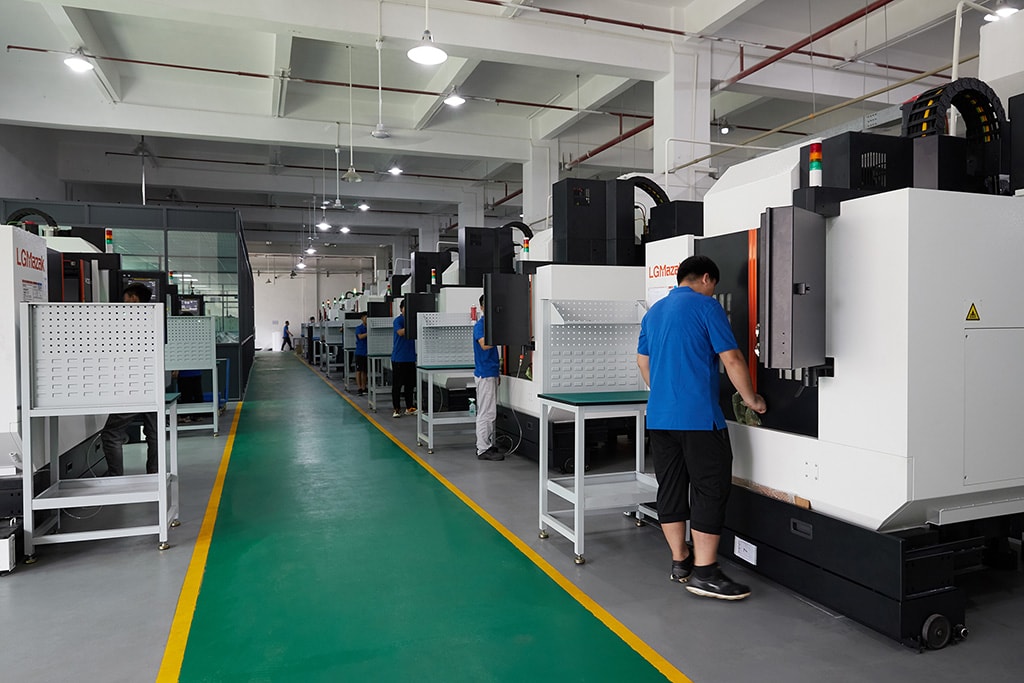
- 100+ machines: 3-axis (50+), 4-axis (20+), 5-axis (20+), 25+ lathes, 7+ grinders.
- Lead tiers: ~3 / 7 / 30 days, set by process steps.
- Facility: 6,800 m², 100+ employees, 20+ inspection instruments.
- Materials: aluminum, stainless, alloy steel, brass, copper, titanium, plastics.
1. How does the manufacturer's capacity set lead times?
The 100+ machines and the 3/7/30-day tiers are linked. Breadth of equipment means a job routes to the machine that cuts it fastest, and a 6,800 m² floor with 100+ employees runs prototype and production volumes without rescheduling the whole shop. A narrow shop slips; a broad one absorbs.
The link cuts both ways. A manufacturer that quotes a short date against a narrow floor will quietly push your job when a larger order lands. Ask for the machine mix behind the date, not the date alone — a promise with no routing behind it is a guess.
2. Which machine mix keeps a lead time short?
Every setup a part avoids is a day it saves. The machine mix is what makes that possible: a 5-axis center cuts a complex part in one setup, and a mill-turn lathe holds concentricity on a cross-drilled part without a second operation.
| Process | Capacity | Lead-time effect |
|---|---|---|
| 3-axis milling | 50+ centers | Fast for flat, prismatic parts |
| 4-axis milling | 20+ centers | Indexed features without refixturing |
| 5-axis milling | 20+ centers | Angled faces in one setup |
| CNC turning | 25+ lathes | Round parts, up to Ø720 × 1280 mm |
| Mill-turn | Multi-task centers | One setup for concentric parts |
| Grinding | 7+ machines | ±0.002 mm finishes |
The point is not the machine count alone. It is that the mix lets the planner pick the fewest-setup route: an angled face goes on the 5-axis, a cross-drilled round part stays on the mill-turn. Fewer setups means fewer chances to lose a day to fixturing.
3. Which materials does the manufacturer run on schedule?
Material availability is part of the schedule. We machine the alloys buyers draw and XRF-check every incoming lot against the mill certificate, so a material problem does not surface as a late shipment.
| Material family | Grades | Lead-time note |
|---|---|---|
| Aluminum | 6061, 6063, 6082, 7075 | Fast, widely stocked |
| Stainless steel | 303, 304, 316, 17-4PH | Common grades on hand |
| Alloy steel | 1018, 1045, 4140, 4340, 12L14 | 12L14 free-machining |
| Brass / copper | C360, H62, C110 | Free-cutting |
| Titanium | TA2, TC4 | Slower cutting, plan accordingly |
| Plastics | ABS, POM, nylon, PTFE, PEEK | Soft, fast |
4. How do secondary operations stretch the schedule?
Secondary operations are where lead times quietly grow. A part that needs anodizing, plating, or heat treatment leaves the building for a qualified partner, and that hand-off adds days. We run these in parallel where possible and state the honest total up front.
- Surface finishing: standard and hard anodizing, plating, powder coating, painting, brushing, polishing.
- Heat treatment: vacuum, bright, carburizing, nitriding, stress-relief aging. In-house ovens reach 500 °C; titanium stress relief above that goes to a qualified partner.
5. What tolerance capacity backs the schedule?
A tight tolerance does not just cost more — it can add a finishing operation and stretch the schedule. Our tolerances are tied to process: ±0.003 mm for milling and turning, ±0.002 mm for grinding, verified on Hexagon CMMs with Cpk 1.851 demonstrated. Knowing what each process holds lets the planner route the part once, correctly.
Read the tolerance band before you read the index. Cpk is a ratio of the tolerance band to the process spread, not an absolute measure of accuracy. The figure above was recorded on a length characteristic with a 0.4 mm band (76.1–76.5 mm) — wide by design. Hold the same process spread against a ±0.005 mm feature and it fails outright. Ask for the band, the subgroup count and the sampling window on every capability number a supplier quotes.
| Process | Held tolerance | Verification |
|---|---|---|
| Milling | ±0.003 mm | Hexagon CMM |
| Turning | ±0.003 mm | Hexagon CMM |
| Grinding | ±0.002 mm | CMM plus surface finish |
6. How does the manufacturer plan for volume?
Capacity planning is a two-way street. Tell us your annual volume and your ramp, and we reserve capacity so production lead times do not surprise you. Because the same equipment runs prototypes and production, the lead time you validate on a prototype is the lead time you can plan on in volume.
Volume planning works only when both sides commit. Before you share a forecast, confirm three points:
- Does the reserved capacity survive a spike in someone else's order? Ask how allocation is protected.
- Is the prototype process the same as the production process? If they differ, your validated lead time means little.
- Who confirms the ramp dates? Get a named planner, not a generic inbox.
7. What red flags signal a weak delivery promise?
- One flat lead time for every part. The manufacturer has not read the drawing.
- No machine count named. A delivery promise without capacity behind it is a guess.
- Finishing ignored. A quote that skips anodizing or plating will slip when the part leaves the building.
8. Which part shapes route through the schedule fastest?
Shape decides the machine, and the machine decides the queue. A round part with a turned bore goes to a lathe and is often done in one setup; a prismatic bracket with milled faces goes to a 3-axis; a part with angled faces and cross-holes goes to a 5-axis or a mill-turn. The part that matches a standard machine routes faster than the part that needs a specialist.
The rule of thumb is simple: fewer setups means a shorter date. A round part that turns and mills in one chucking beats the same part bouncing between a lathe and a mill. When you look at a drawing, count the setups the shop will need, that count is a rough preview of the lead-time tier.
| Part shape | Typical machine | Schedule profile |
|---|---|---|
| Round shafts, pins, bushings | CNC lathe | One setup, fast |
| Prismatic plates, brackets | 3-axis mill | One or two setups |
| Cross-drilled round parts | Mill-turn | One setup for concentricity |
| Angled faces, compound angles | 5-axis mill | Fewer setups than 3-axis |
9. How does geometry decide the machine, and the date?
Geometry is the schedule's input signal. Internal corners, deep pockets, thin walls, and tight bores each push the part toward a different machine and a different cycle time. A sharp internal corner needs a small tool and a slow pass; a deep pocket needs a long-reach cutter that deflects; a tight bore needs a boring bar and a careful feed.
The shop reads the geometry and routes the part once, correctly. That is the difference between a part that ships on the first date and one that reworks its way to a second. When the geometry is friendly — relaxed radii, workable walls, standard threads — the route is short and the date holds.
If the geometry is hostile, the shop should tell you before quoting, not after the tool breaks. A DFM note that says "this corner cannot be cut as drawn" saves you a schedule slip; silence about it costs you one.
10. What do the material grades mean for a part's delivery?
Material is both a property and a schedule factor. The grade sets the cutting speed, and the cutting speed sets how long your part occupies a spindle. The same geometry in 6061 aluminum and in 316 stainless can land in different lead-time tiers, because one cuts in minutes and the other takes longer per part.
| Grade | Typical part | Delivery note |
|---|---|---|
| 6061-T6 aluminum | Housings, brackets | Fast; short tier |
| 7075-T6 aluminum | Structural, aerospace | Slightly slower |
| 303 / 304 stainless | Corrosion parts | Work-hardens; longer |
| 316 stainless | Marine, chemical | Slowest of the common stainless |
| 4140 alloy steel | Shafts, gears | Machines well annealed |
Name the grade in your drawing, not just the family. "Aluminum" is a family; "6061-T6" is a spec. The grade is what lets the shop commit to a date instead of a guess.
11. How do you spec a part so it ships on time?
The drawing is the schedule's instruction set, and a well-specified part ships faster than a vague one. The three fields that move the date are the tolerance, the surface finish, and the secondary process. State them, and the shop can route and date the part in one pass.
- Tolerances only where function demands. Every over-tight callout adds a pass or an inspection.
- Surface finish as a number. Ra 1.6 µm means a specific process; "smooth" means nothing.
- Finishing and heat treatment named. If the part is anodized or hardened, say so at the start.
- A general tolerance standard. ISO 2768-m removes the ambiguity on undimensioned features.
A complete spec turns the quote into a routing. An incomplete one turns it into a question, and every question costs a day.
12. Which features add the most lead time to a part?
Some features are cheap to draw and expensive to schedule. Deep holes, sharp internal corners, thin walls, and fine threads each add time that has nothing to do with how big the part is. Knowing which ones cost you lets you design them out or plan for them.
| Feature | Why it adds time | Fix |
|---|---|---|
| Sharp internal corners | Needs a small tool and slow pass | Add a radius; a standard end mill then works |
| Deep pockets / holes | Long-reach tools deflect and break | Shallow the pocket or open the corner |
| Thin walls | Chatter forces slower feeds | Thicken the wall or add a support rib |
| Non-standard threads | Special taps must be ordered | Use a standard size where possible |
Every one of these is a decision you make in CAD that shows up later on the calendar. Design them out and the date shortens without the shop doing anything differently.
13. How does a part's tolerance split the schedule?
Tolerance splits a part between machines. A dimension at ±0.05 mm finishes on the mill or lathe in a normal pass; a dimension at ±0.003 mm may need a finishing pass; a dimension at ±0.002 mm needs the grinder. Each split adds an operation, and each operation adds a queue.
| Tolerance band | Process | Schedule effect |
|---|---|---|
| ±0.1 mm / ±0.05 mm | Standard milling or turning | No extra step |
| ±0.003 mm | Milling or turning with a finishing pass | One extra pass |
| ±0.002 mm | Precision grinding | Adds a dedicated step |
The honest move is to tolerance only the dimensions that matter and leave the rest to a general class. A part with one ±0.002 mm bearing seat and everything else at ±0.1 mm routes far faster than a part where every dimension is tight for no reason. Put the tolerance where the function lives, and the schedule follows the part, not the print.


Frequently Asked Questions
How does the manufacturer's capacity set lead times?
The 100+ machines and the 3/7/30-day tiers are linked. Breadth of equipment means a job routes to the machine that cuts it fastest, and a 6,800 m² floor with 100+ employees runs prototype and production volumes without rescheduling the whole shop.
Which processes does the manufacturer run?
3-axis (50+), 4-axis (20+), and 5-axis (20+) milling, 25+ CNC lathes, mill-turn centers, and 7+ grinders. Mazak, Brother, Citizen, Star, and Tsugami machines cover the full metal-cutting range.
What tolerances can the manufacturer hold?
±0.003 mm for milling and turning, and ±0.002 mm for precision grinding. Critical dimensions are verified on Hexagon CMMs, with Ppk ≥ 1.67 at the initial study on key characteristics and ≥ 1.33 on general characteristics.
What is the minimum order quantity?
One piece. There is no forced production minimum, so you can machine a prototype, validate it, and scale into production on the same drawing and process.
Which materials does the manufacturer machine?
Aluminum, stainless steel, carbon and alloy steel, brass, copper, titanium, and magnesium, plus engineering plastics. Incoming bar is XRF-checked against the mill certificate before machining.
How do I get a quote with a delivery date?
Email your STEP, IGES, or 2D drawing to [email protected]. The reply includes a DFM review, an itemized quote, and a lead-time estimate tied to the part's actual process steps.
Which part features slow a schedule down the most?
Deep holes and pockets, sharp internal corners, thin walls, and non-standard threads. Each forces a slower feed, a special tool, or an extra setup. Relaxing a radius or opening a corner often pulls a part back into a faster tier without changing how it works.
Does the material grade change the delivery date?
Yes. The grade sets the cutting speed, so 6061-T6 aluminum routes faster than 316 stainless on the same geometry. Naming the exact grade in the drawing lets the shop commit to a date instead of guessing at a family.
Get a delivery date backed by capacity
Send your drawing to [email protected] or call +86 13126536955 for a quote and an honest lead-time estimate.